News



Najnovije iz eTrgovine
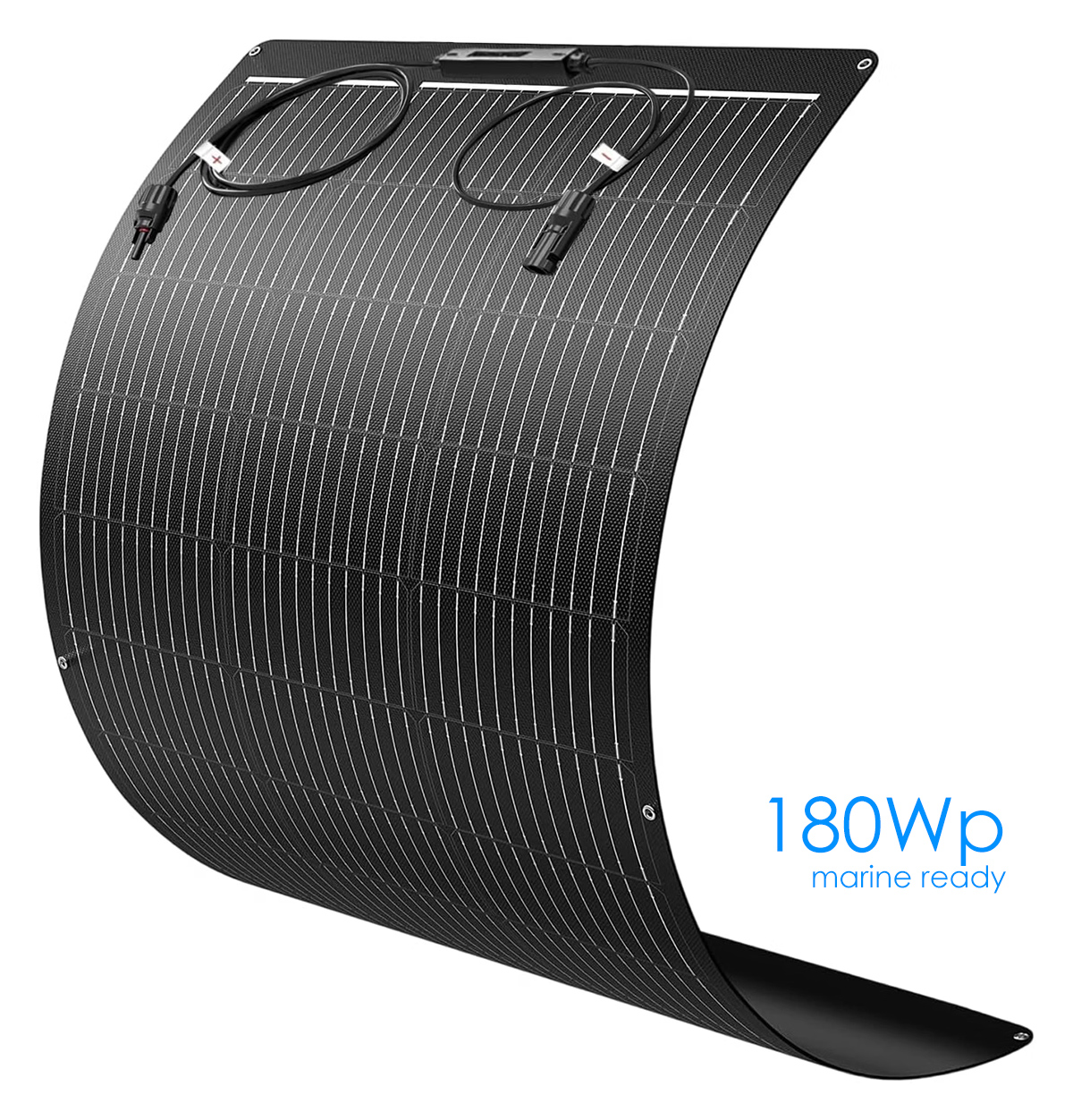 329.00€
Solarni paneli na plovilih postajajo del nujne opreme. Zagotavljajo večjo samostojnost od postankov na kopnem ali gnanja motorja zgolj zaradi porabe električne energije. Ker pa smo na plovilu omejeni s prostorom in površine niso ravne, pridejo v poštev fleksibilni solarni paneli, ki imajo visoke izkoristke in so upogljivi.
Solarni panel BlueCell 180Wp zagotavlja širok spekter uporabe: Zelo je primeren za polnjenje 12-voltnih svinčenih akumulatorjev in litijevih baterij. Za polnjenje 24- ali 48-voltnih akumulatorjev je mogoče zaporedno povezati več panelov. Panele je potrebno priključiti preko solarnega regulatorja polnjenja.
Številne možnosti uporabe
Upogljivi solarni panel omogoča krivljenje do polmera 40 cm. Namestite ga lahko na plovila, prikolice, koče, šotore, osebna in tovorna vozila, jahte, strehe ali katero koli drugo nepravilno oblikovano površino.
Visoka učinkovitost pretvorbe
Visokoučinkovite monokristalne sončne celice z edinstveno tehnologijo zadnjih kontaktov (back-contact) odpravljajo potrebo po elektrodah na sprednji strani celic, ki bi sicer blokirale sončno svetlobo, s čimer se učinkovitost pretvorbe solarnega panela poveča za do 30 % v primerjavi z običajnimi izvedbami.
Kakovostni materiali
Solarni panel je izdelan iz materiala ETFE. Ta material odlikujeta večja prepustnost svetlobe in daljša življenjska doba v primerjavi z običajnimi materiali, kar zagotavlja vrhunsko delovanje dan za dnem. Hrbtna stran panela je izdelana iz materiala TPT, ki omogoča dobro odvajanje toplote, je vodoodporen, odporen na visoke temperature.
Tehnični podatki:
- Največja moč (Wp): 180W
- Napetost (Voc): 24,30V
- Napetost (Vmp): 19,20V
- Tok (Isc): 10,25A
- Tok (Imp): 9,38A
- Sistemska napetost (max): 1000V
- Toleranca: 3%
Zadnji video



The Vela Code and the Real Impact of Avoiding Single-Use Plastic in Yachting
Yachting, like every other sector, is currently navigating a necessary green passage. Not just because it's the trend of the moment or the right thing to do — but also, and above all, because the world of yachting, long synonymous with extreme luxury, is desperately seeking a more sustainable and socially acceptable narrative.
A new identity that speaks not only to yacht owners, but also to a broader, non-nautical audience increasingly sensitive to the environmental cost of privilege.
This is the context in which the Vela Code was born.
It is not just a sustainability initiative. It is a call to conscience. Founded by yacht designer Dan Lenard, co-founder of the Nuvolari Lenard studio, the Vela Code invites all actors in the yachting sector — from builders to crew, suppliers to clients — to a simple, concrete act: to avoid, as much as possible, the use of single-use plastic onboard.

The Fundamental Question
Does it make sense to talk about green propulsion while we are still choking the very ocean we depend on? The answer is no. Cleaner engines are essential, but not enough. If we don't protect and restore the ocean's natural ability to absorb CO₂, we are sabotaging a critical part of the climate solution.
Two Approaches, Two Impacts
Cleaner Propulsion (hybrid, hydrogen, electric)
Advantages:
- Seen as technologically advanced
- Aligned with global green mobility trends
- Attractive to innovation-driven clients
Disadvantages:
- Slow to implement — only affects new builds
- Expensive — out of reach for many
- Not unique to yachting — it's a global transport issue
- Often powered by non-renewable energy
- Invisible to guests

Image Impact: Responsible, but distant. Emotionally disengaging.
Avoiding Single-Use Plastic in the Galley
(e.g. no plastic bottles, no cling film, only reusable or compostable containers)
Advantages:
- Immediate, visible, and tangible
- Easy to implement across the entire industry
- Unique in the context of luxury
- Low cost, high symbolic value
- Strong message: "Even luxury can be responsible"
- Speaks directly to a new generation of environmentally-conscious clients
Disadvantages:
- Less technological appeal
- Possible resistance from crew or suppliers used to convenience
- Doesn't directly reduce CO₂ — but helps preserve the ocean's capacity to do so

Image Impact: Strong, emotional, authentic.
Yachting appears aware, modern, and in harmony with the sea.
So which has the greater impact — real and perceived?
- The invitation to avoid single-use plastic.
- It's tangible. It's actionable now.
- And it sends a message that transcends the deck of a yacht:
- "We don't just build beautiful objects — we protect the seas they sail on."

Vision of the Vela Code
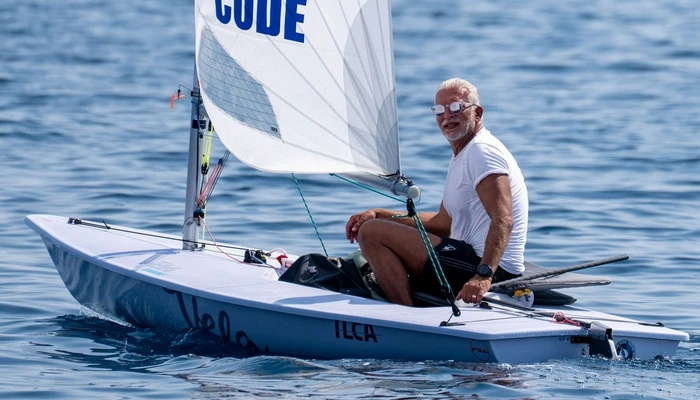
Dan Lenard's solo Atlantic crossing — without engine, without GPS, and without single-use plastic — was not a media stunt. It was a statement. One that resonated with environmentalists, journalists, young people, and the entire yachting industry. Today, the project continues aboard Vela — formerly Telefónica Black, the VOR 70 from the Volvo Ocean Race — transformed into a roving platform for environmental education. A floating classroom educating young sailors and the public about marine conservation and the impact of plastic pollution. And on June 14, 2025, Dan Lenard will attempt another symbolic yet concrete feat: 500 miles of endurance on an Olympic Laser dinghy — no engine, no emissions, no single-use plastic. A radical yet consistent gesture. A demonstration that sustainability is not sacrifice — it's courage, vision, and elegance.
What Do We Propose?
A simple but powerful invitation to the yachting industry:
Avoid single-use plastic onboard as much as possible.
- No plastic bottles
- No cling film
- Only reusable or compostable containers
This isn't radical — it's responsible. A step that is accessible to all, with real, immediate impact, and a strong contribution to the image of sustainable luxury. Let's not wait until 2035 for hydrogen engines. Let's act today. Let's make the ocean part of our brand again.

Yachting as a Cultural Force
People in the yachting world spend most of their time on land. Precisely for this reason, environmental initiatives that begin at sea can — and should — come ashore as cultural trends. Rather than relying solely on awareness campaigns or individual morality, yachting can influence through style. When luxury leads by example, behavior becomes aspirational.
A movement becomes a fashion. And fashion spreads.
- If "plastic isn't cool" becomes a social norm,
- If "plastic is ugly" becomes a shared aesthetic instinct,
- The shift happens — and it lasts.
- And this is where the Vela Code comes in:
- Not as regulation, but as a way of life.
- It doesn't impose — it inspires.
- It doesn't dictate — it seduces.
- It reframes sustainability in yachting not as moral duty, but as aesthetic intelligence. As elegance.

An Icon, Not Just a Boat
Vela (ex Telefónica Black), restored, is more than a platform — it's a declaration of style, vision, and coherence. From the solo Atlantic crossing to the upcoming 500-mile endurance challenge, every mission by Dan Lenard speaks to a single vision: To make sustainability iconic. The Vela Code aims to transform the rejection of single-use plastic into a symbol of smart luxury — an idea beautiful enough to break out of yachting and shape a broader culture of living. Because in a world drowning in plastic, nothing is more fashionable than a clean sea.


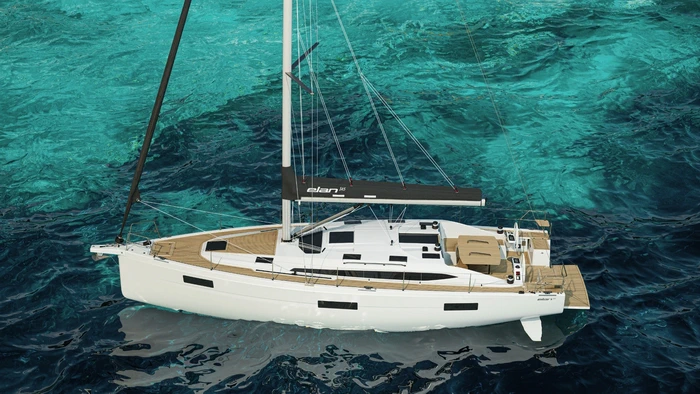
At Elan Yachts, we are expanding the customisation options for our popular Impression 45 model, offering more choices for interior finishes and materials. Previously available with a rustic oak interior and grey cupboard fronts, the Impression 45 will now be offered with three additional wood finishes:
- Natural Oak
- Natural Oak Brushed
- Natural Oak Brushed & Whitened
In addition to the expanded wood choices, we are now giving owners the ability to personalise the colour of the galley cupboard fronts and countertops, allowing for even greater flexibility in interior design. Customers can choose from a plethora of different color options for galley cupboard and cabinet fronts, as well as counter colorus, allowing them to mix and match - creating a virtually infinite amount of creative combinations.
A Designer’s Perspective on the New Interior Palette
To explore the potential of these new material options, we invited an interior designer to create some example configurations from all of the available options. The designer chose Natural Oak Brushed & Whitened as the base finish, noting that its soft, textured appearance provides a refined backdrop for a wide range of colour options. “This lighter oak finish works beautifully with pastel tones, offering a fresh and modern aesthetic that feels both elegant and inviting”, the designer explained.
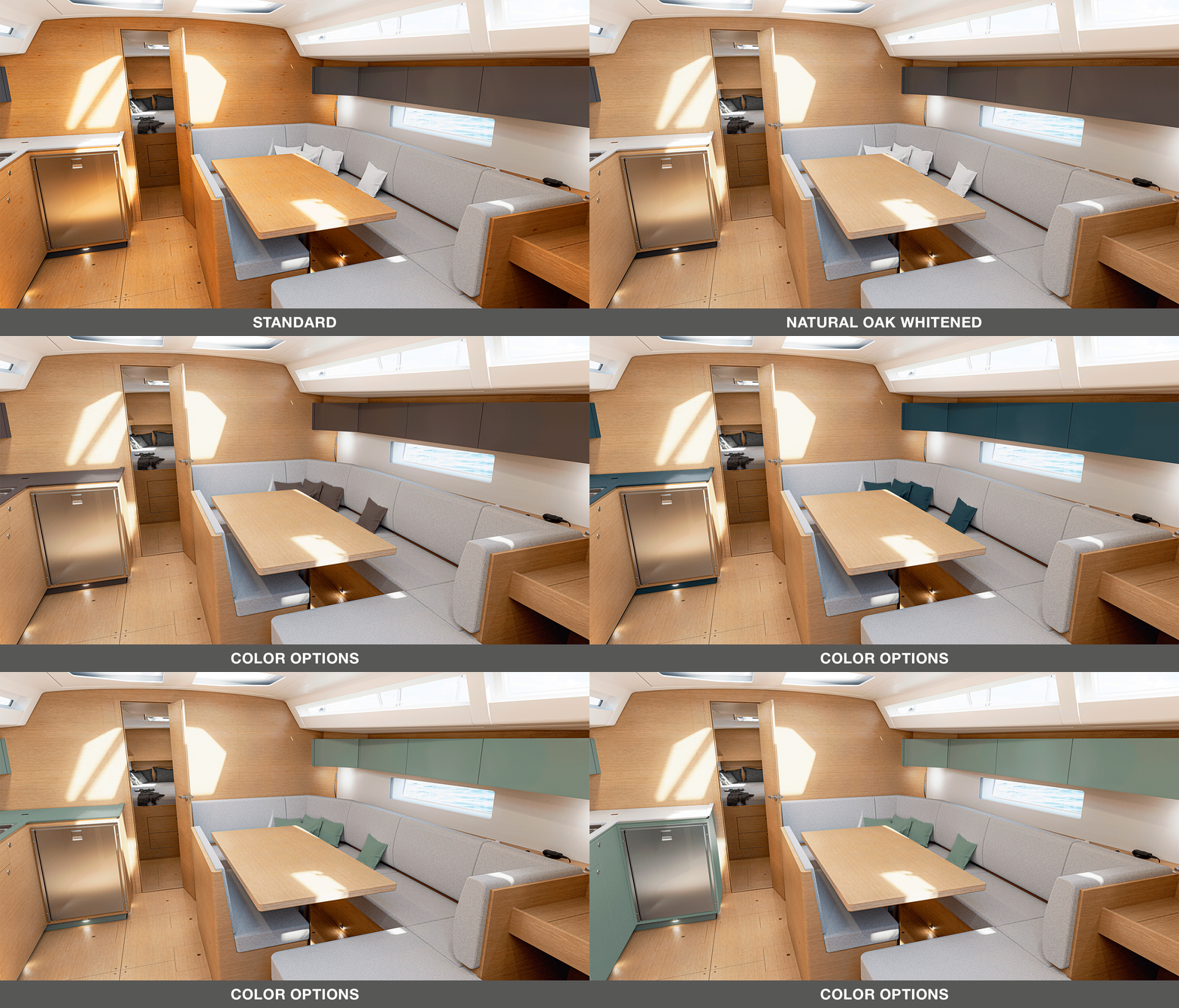
From there, three distinct colour combinations were selected for the galley cupboard fronts and countertops:
Deep Blue – “A sophisticated, modern choice reminding us of an elegant city apartment, bringing depth and contrast to the interior.”
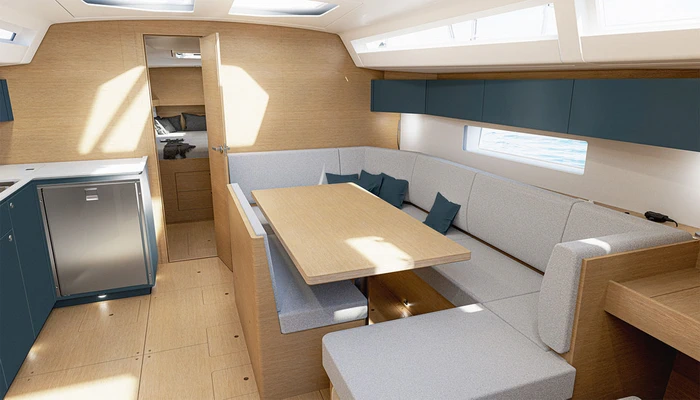
Cacao – “A warm, earthy tone that enhances the natural wood elements, creating a cosy, welcoming space, while keeping within the tradition of nautical interiors.”
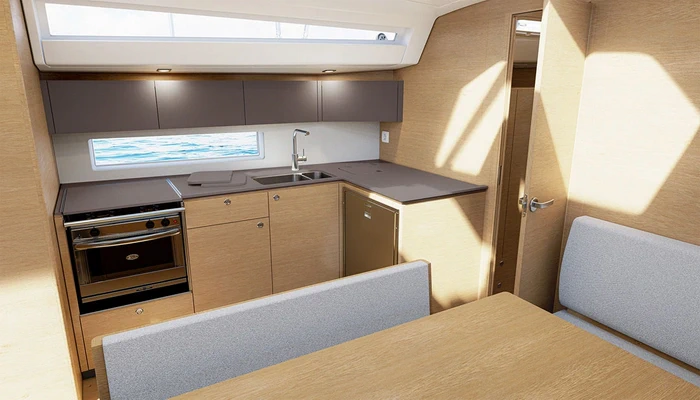
Eucalyptus – “This is my favourite combination—light, warm, and effortlessly modern. The unique pale green tone stands out while maintaining a sense of balance between warmth and style.”
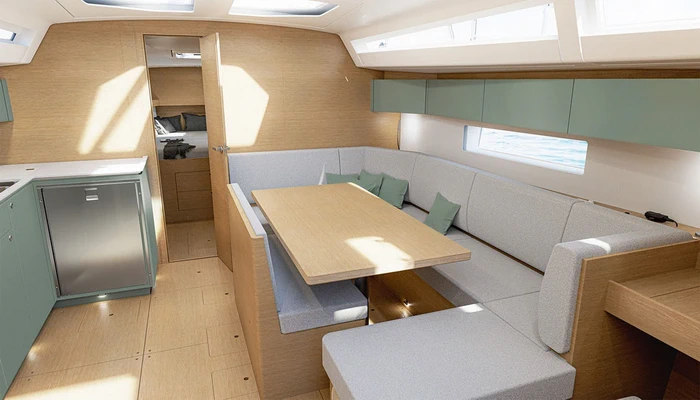
The Impression 45 is built with safety, comfort, and easy sailing in mind, and yet its performance stands out in its class. Thanks to smart naval architecture by Humphreys Yacht Design, it delivers better speed and handling than many comparable cruising yachts. What also sets it apart is our own 75-year-old in-house carpentry workshop, where our experienced craftsmen create interiors that blend modern elegance with traditional craftsmanship. The Impression 45 features high-quality wood finishes, solid wood details, and durable construction—contrasting with many competitors who rely on lighter, easy-to-assemble materials.
These updates reflect our commitment to offering more customisation while maintaining the build quality and craftsmanship that define the Elan Yachts brand. The new material options are available for all newly ordered Impression 45 models, starting immediately.